During the period under review, new issues of 38 journals appeared (including one double issue). Despite applying a stringent selection, I was unable to reduce the list below 20 texts: such was the wealth of interesting subjects addressed in the academic journals covered by this review.
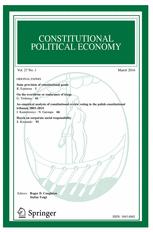
The review opens with a journal somewhat less frequently featured in these pages, CONSTITUTIONAL POLITICAL ECONOMY (36/2025), which published the article “Non-compliance as a determinant of constitutional change? A comparative study”. A. Schnelle sets out to answer a recurrent question: are constitutions whose provisions are not observed amended more frequently, and, if so, does this take the form of total constitutional change in the formal sense (the adoption of a new constitution), or rather partial change (constitutional amendment)? The empirical material is impressive: the study covers the constitutions of 170 countries between 1950 and 2018. Its point of departure is the so-called de iure/de facto gap, that is, the discrepancy between what a constitution guarantees and what is actually implemented in practice.
The findings are more interesting than one might expect. Constitutional non-compliance does not simply lead to more frequent changes to the constitutional text. In the case of partial constitutional change, no relationship was found between the degree of constitutional compliance and the frequency of amendment. In the case of total constitutional change in the formal sense, however, the relationship is clear: the greater the discrepancy between constitutional promises and reality, the greater the likelihood that the constitution will be replaced by a new one (amendments accounted for 90% of all constitutional changes recorded in the sample).
The gap in question most frequently concerned political and civil rights, including freedom of association, assembly, the media and expression: in other words, precisely those rights whose effective enjoyment and observance should make it easier for citizens to organise pressure for systemic change.
The author draws an interesting lesson for constitution-makers: excessively ambitious, “utopian” constitutional promises may ultimately work against the constitution itself. If they remain merely on paper, rather than strengthening constitutional durability they may increase the risk that the constitution will be replaced altogether. In other words, constitutional non-compliance does not lead to more frequent “repairs” of the constitution, but is associated with a greater likelihood of its complete replacement by a new one.